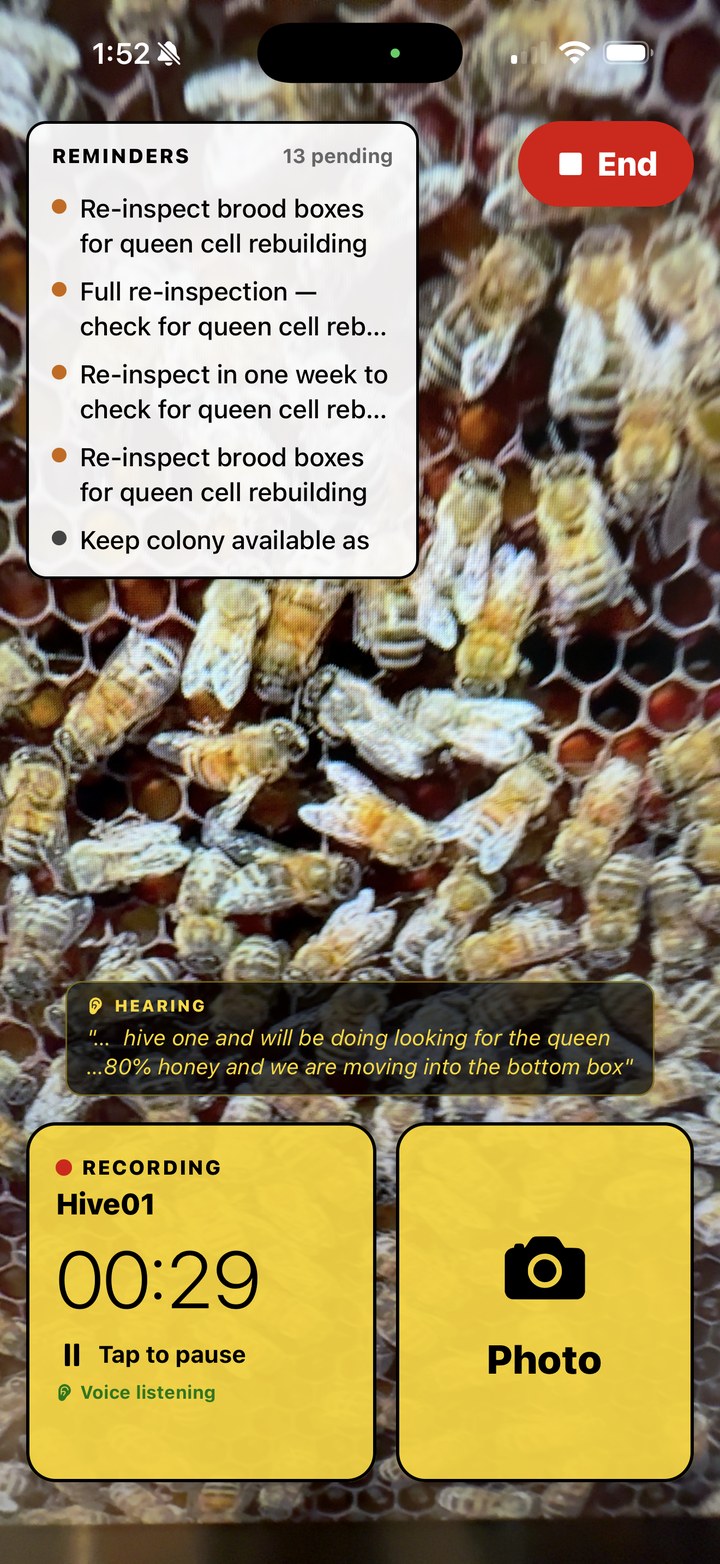
Live capture
Inspection in progress.
Three buttons, no menus. Big enough to navigate with gloves and a veil, but also fully voice controlled so you don’t have to. Start, stop, pause, resume, and photos — all live voice commands.
Voice-first inspection capture, scientific models that turn what you saw into what’s coming, and a place to share both with the hivemates who’ll help you handle it. The keeper’s side of the conversation.
2024–25 was the worst loss year on record for U.S. beekeepers. The colonies we lose aren’t just gone — they’re hundreds of dollars and a season of work gone with them.
Hobbyist keepers (1–49 hives) lost roughly half their colonies last season — well above the ~40% decade average.
A 2026 nuc with a mated queen runs $200–$300. Packages are cheaper but slower to build up. Add equipment and your time on top.
Keepers who manage varroa lose 38.8% of colonies. Those who don’t lose 51.3%. Same bees, same weather — different outcomes.
1 Apiary Inspectors of America & Auburn University, 2024–25 U.S. Beekeeping Survey (preliminary). 2 Aggregated 2025–26 retail nuc/package pricing. 3 Bee Informed Partnership, average winter loss 2010–2018, varroa-managing vs. non-managing backyard keepers.
Waggl is built around the things that move those numbers — catching varroa before it tips, treating on time, learning from what worked across the apiary and the region.
Earlier mite detection, on-time treatments, and shared learnings from nearby apiaries — the levers Waggl pulls to close the varroa survival gap.
Earlier supering, fewer mid-season collapses, healthier brood at the flow — the things voice capture and predictive timing actually move.
Honey, nucs, queens, sponsorships — sold direct through your Waggl profile to people who already know your hives.
The colony broadcasts. The keeper observes. Waggl is the layer that catches everything you said and saw without you having to type a word.
“Queen looks good, eight frames of brood, two of honey, did an alcohol wash and got six mites.” Waggl pulls out the observations, updates the hive model, logs the honey, and queues the action items. Snap a photo and it’s tagged to the right hive automatically.
Walk five hives in a row without touching the screen. “Hey Waggl, snap.” “Hey Waggl, pause.” “Hey Waggl, next hive.” When you’re done with one and ready for the next, just say so. Photos, transitions, pause-resume — all spoken.
Phone in your pocket. AirPods under the veil. A wired headset clipped to your jacket. Waggl listens through whatever’s connected. A purpose-built wearable mic + camera (the Waggl Node) is on the way for keepers who want better pickup and hands-on-frame photos.
Capture works fully offline — recordings queue locally and process when you’re back on signal. If the app force-closes mid-inspection, tap the recovery banner on next launch and pick up exactly where you left off. The bee yard is rough on phones. Waggl is built for that.
Mites, swarms, queens going, dearths, treatment windows closing. Most of what scares beekeepers is predictable if you have the right numbers in front of you. Waggl runs the math behind the scenes and tells you what to do next.
Every mite count you log feeds a per-hive projection — and a baseline model runs continuously, so even the hives you haven’t had time to monitor stay tracked. Waggl ranks viable treatments against your weather window, supers on or off, hive type, and what nearby apiaries are seeing — no generic “treat in fall” advice, just the products and dates that fit your apiary this week.
Waggl reads what you said during the inspection and pulls out the structured data — mite counts, frame counts, queen sightings, treatments applied, honey added. The model gets fed real numbers without you opening a form.
Every hive carries a live risk score that updates after each inspection — weighted by recent observations, season, and regional pressure. The hives quietly heading toward trouble surface to the top of the apiary view.
Waggl records the action items you say out loud during the inspection — “remind me to check the queen next visit” — and proposes the ones you might have missed: “split this one,” “treat with OAV next visit,” “capped queen cells, watch for a swarm.” Confirm or skip with one tap. No more inspections that end with a notes app you never re-open.
Confirmed action items land on a calendar and fire as notifications at the right time. Supersedure windows, mating-flight holds, post-split and post-requeen “do not disturb” flags — all set automatically from hive events, no manual scheduling. Start an inspection on a specific hive and the open items for that hive surface in the app, so you never have to remember what you were supposed to check.
Local weather + anonymized signals from nearby apiaries feed every prediction. “Today’s a bad inspection day.” “Mite loads in your state are tracking 30% above last year.” Your to-do list reorganizes itself around the weather, the bees, and what’s actually on your calendar — work the hives when conditions are right, not just when an alert fires.
The keepers in your region, the mentor down the road, the family member helping you on a weekend, the friend who’s curious about your bees. Waggl is the place where all of that conversation lives next to the records.
In-app chat that pulls your specific hives, your equipment, your region, the current season. Recommends videos from a vetted catalog of real beekeeping masters (no hallucinated URLs). Proposes action items you can add with one tap.
Invite club members, partners, mentors, or family with role-based access — owner, mentor, viewer. Different levels for different relationships, everyone seeing the right slice of the yard.
Move a single hive — with all its inspections, photos, queens, treatments, and history — to another beekeeper’s account in the app. Reversible if you change your mind. Useful for club nucs, mentor handoffs, hive sales.
Stuck on a frame pattern, an unusual brood gap, a queen you can’t spot? Waggl connects beta keepers with master-keeper volunteers from regional clubs — a real person on the other end, not a forum thread from 2009.
Scroll through a few of the screens you’ll spend time in. Real iOS app, currently in private beta.
Three buttons, no menus. Big enough to navigate with gloves and a veil, but also fully voice controlled so you don’t have to. Start, stop, pause, resume, and photos — all live voice commands.
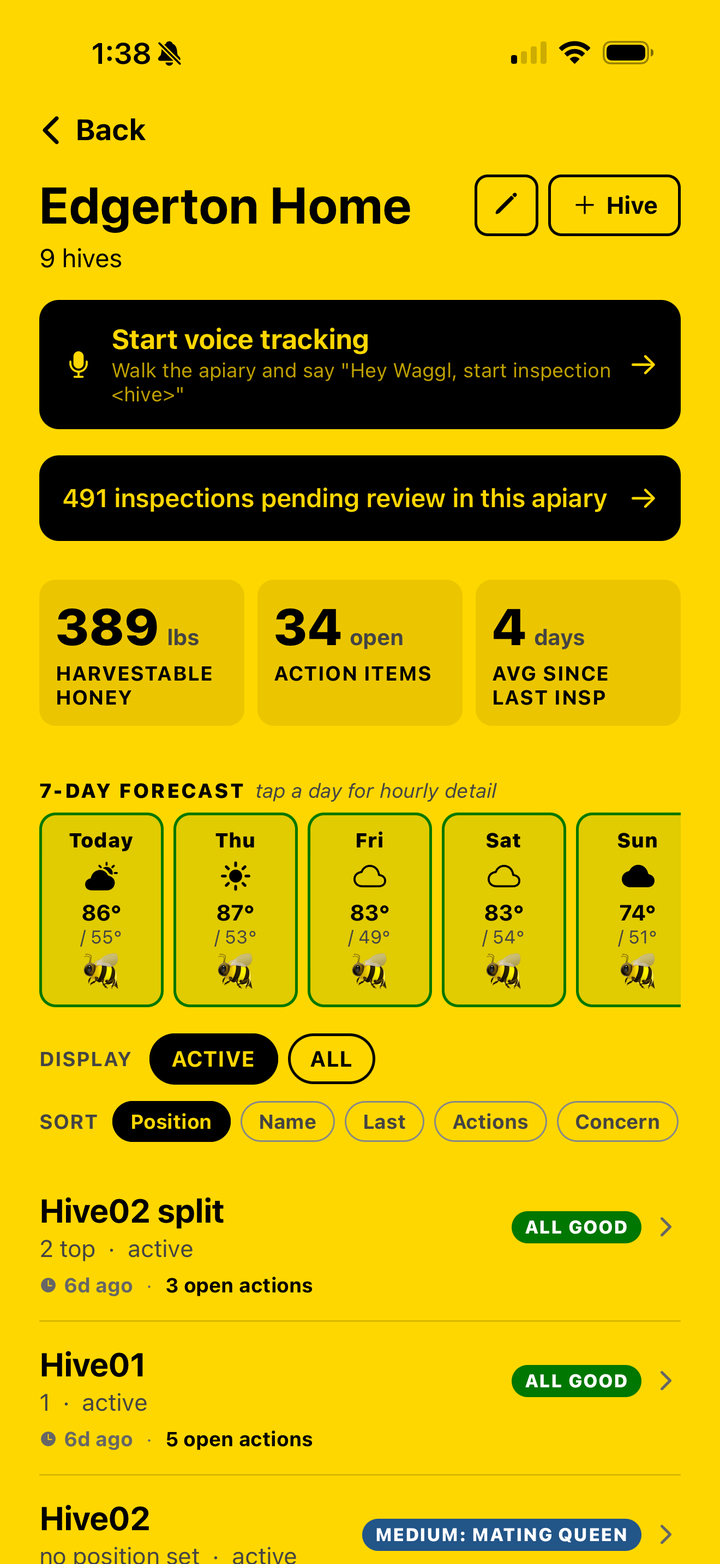
See your whole apiary at a glance. Key metric dashboard and weather forecast let you plan ahead, while individual hives are flagged and sortable by potential concerns and pending action items.
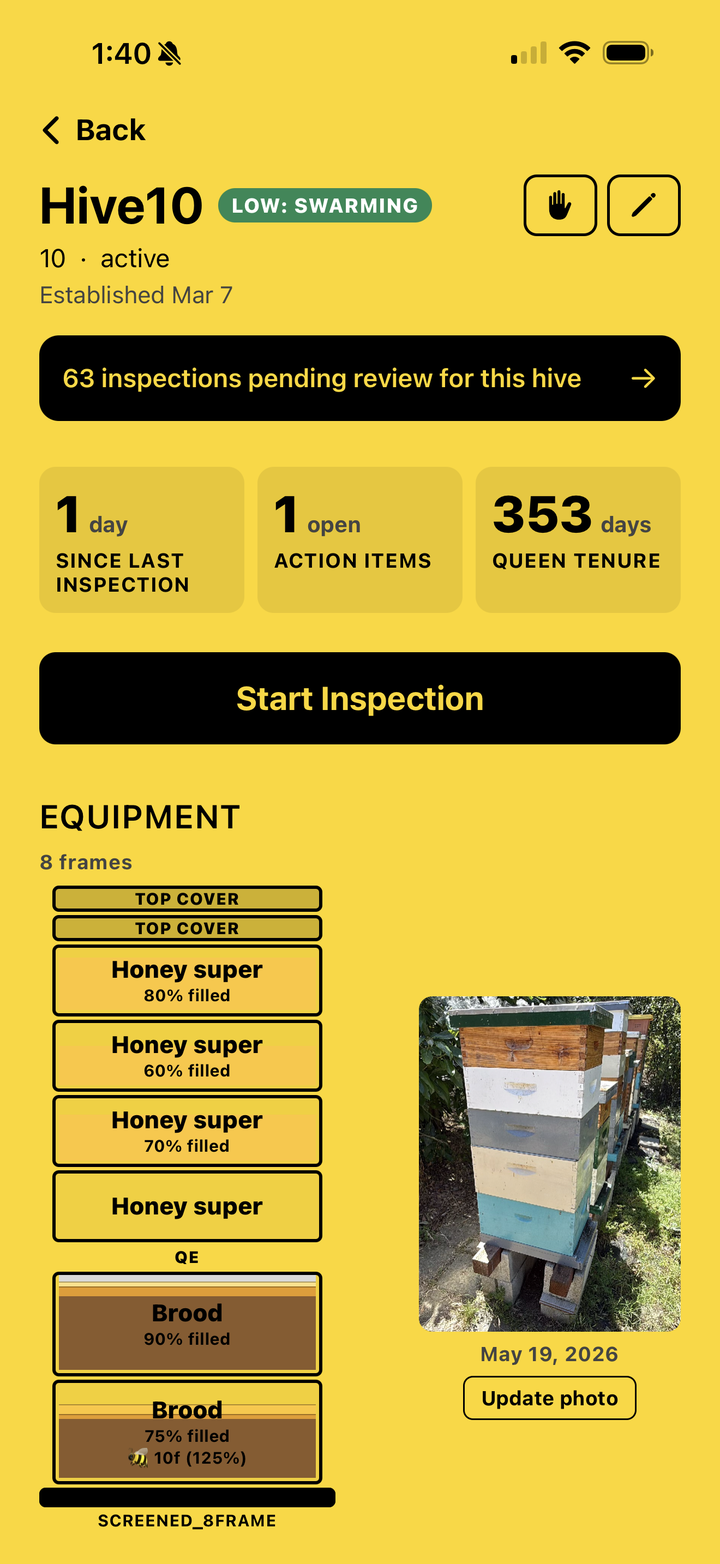
Queen events, brood pattern, honey stores, mite counts, treatments — pulled from what you said into clean per-hive records. Tap on hive boxes to monitor status over time as supers fill. See all your inspection history and track observations over time.
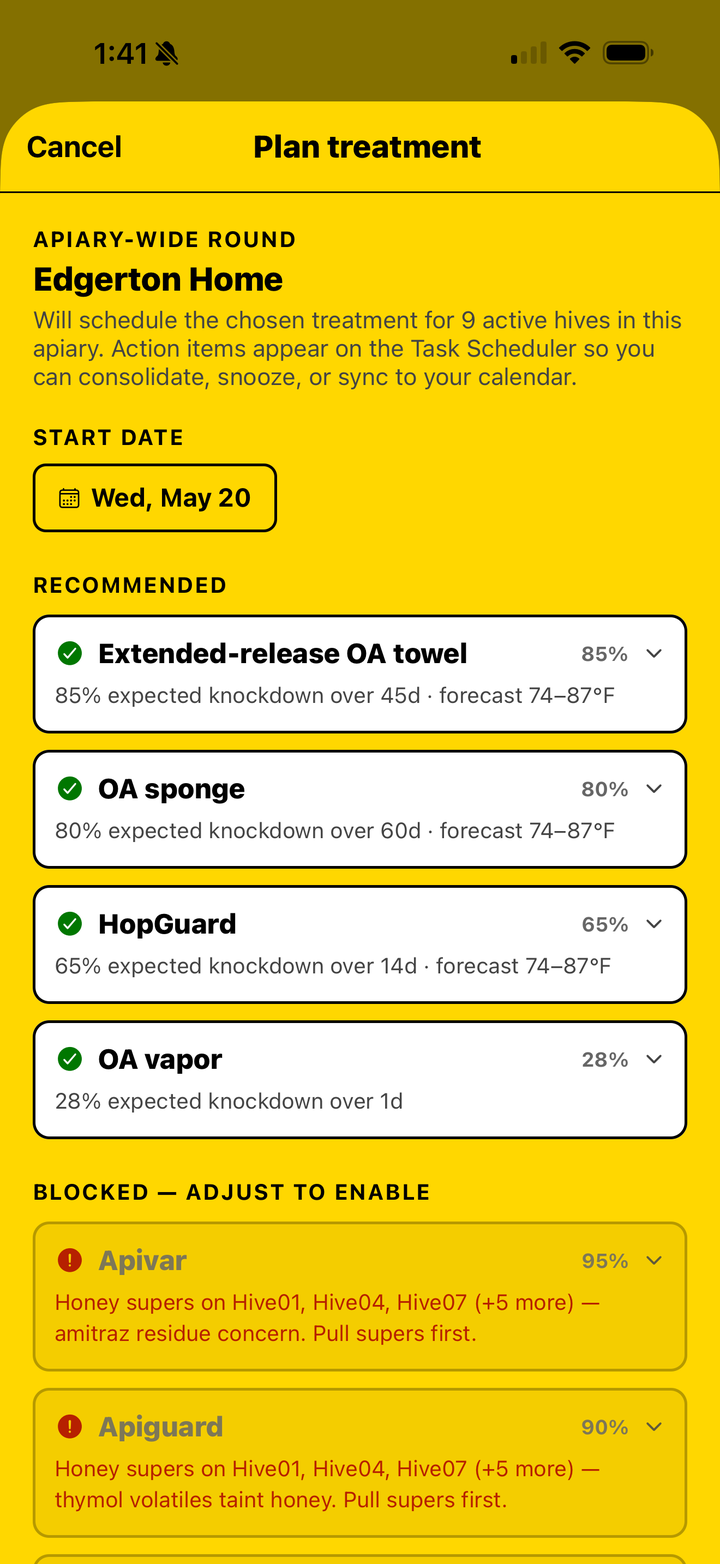
The model ranks treatments against weather, supers, hive type, and what neighbors are using. No generic “treat in fall” advice — what fits this hive, this week.
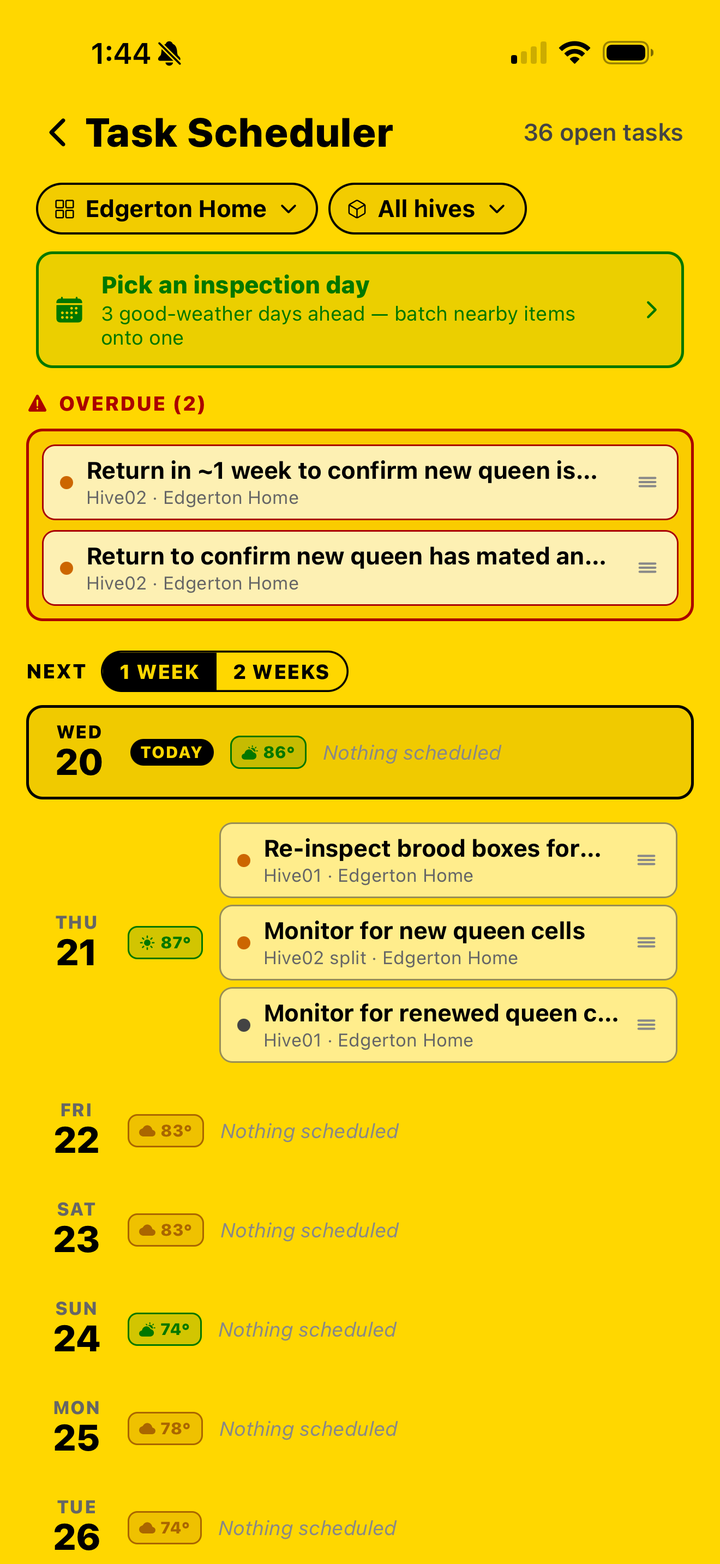
Confirmed action items become reminders timed to weather, hive events, and your schedule. Drag to reorder; the rest of the plan reshuffles around you.
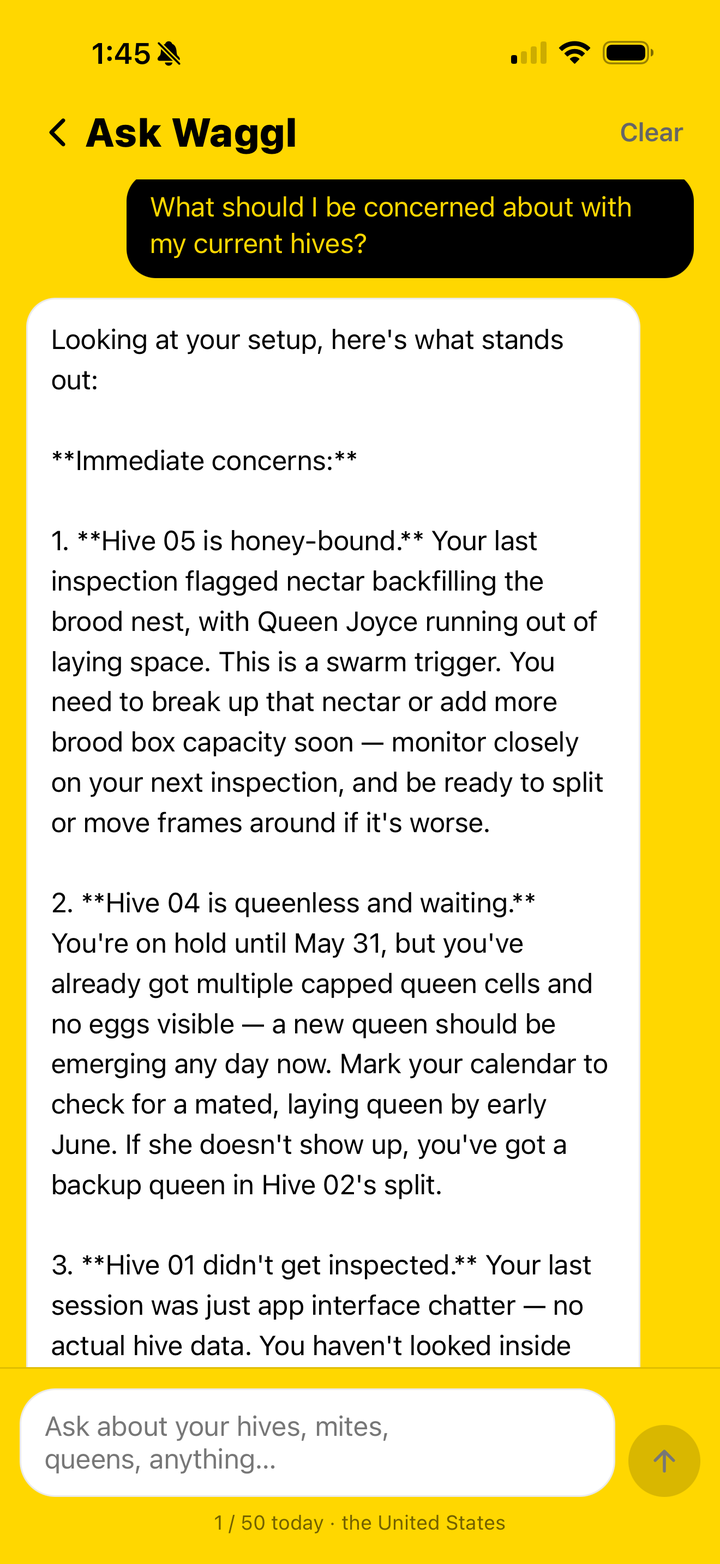
In-app chat that pulls your specific apiary, equipment, region, and season into every answer. Proposes action items you can add with one tap.
Yes. Capture is fully offline — the app records and queues locally. Transcription and AI extraction run when you’re back on Wi-Fi or LTE. Your notes never get stranded.
Right now we support 8- and 10-frame Langstroth setups, but if there’s enough interest, adding other formats is feasible. Most current features still work regardless of your setup — only the automatic hive model updates and equipment inventory will get a little weird. Let us know what hive formats you use!
No. Start simple: pick up the phone, talk through what you saw, and Waggl files it into per-hive records you can read later. The deeper layers (risk scoring, treatment planning) unlock as you have data to feed them. Plenty of first-year keepers use Waggl just to keep a clean inspection log. The mentor channel and apiary sharing are specifically designed for new keepers — get a real master keeper looking over your shoulder as you learn, with all your hive history available for them to see.
The iOS app itself runs anywhere the App Store does (English for now). What doesn’t fully travel yet: the regional intelligence is US-only (USDA NASS + Bee Informed Partnership feeds), and the varroa treatment planner is tuned to products available in the US. The voice capture, AI extraction, hive history, and apiary sharing all work the same anywhere. If you’re outside the US and want to try the beta, we’re happy to have you — mention your country on the beta form so we know which gaps to prioritize.
Our transcription and extraction vendors process your audio under contracts that prohibit training on your data. Waggl itself does learn from your feedback — when you confirm, edit, or skip a suggested observation or action item, that signal helps tune our recommendations over time. Photo annotations may eventually train computer-vision models that give live feedback during inspections (“that looks like chalkbrood,” “that’s a queen cell”). Your recordings, transcripts, and findings remain yours — export or delete anytime.
Extraction is good on the things keepers say clearly — mite counts, queen sightings, frame counts — and weaker on judgment calls. Every AI observation can be edited or deleted, and the system’s logic on turning those observations into overall hive risks is shown to the keeper at every inspection. Your feedback on observations makes Waggl smarter over time, and you can always add your own observations and action items if the AI makes a mistake.
Beta is free. Paid pricing lands when we exit beta — beta testers get grandfather pricing. We’re targeting something a backyard keeper can absorb (think the cost of one nuc per year, max).
Coming after iOS stabilizes. Same backend, same AI pipeline, same features. Mention “Android” on the beta form to land on the testers list.
Beta is free. Beta testers shape the next features and get grandfather pricing when the paid version ships. Bring your hives.